
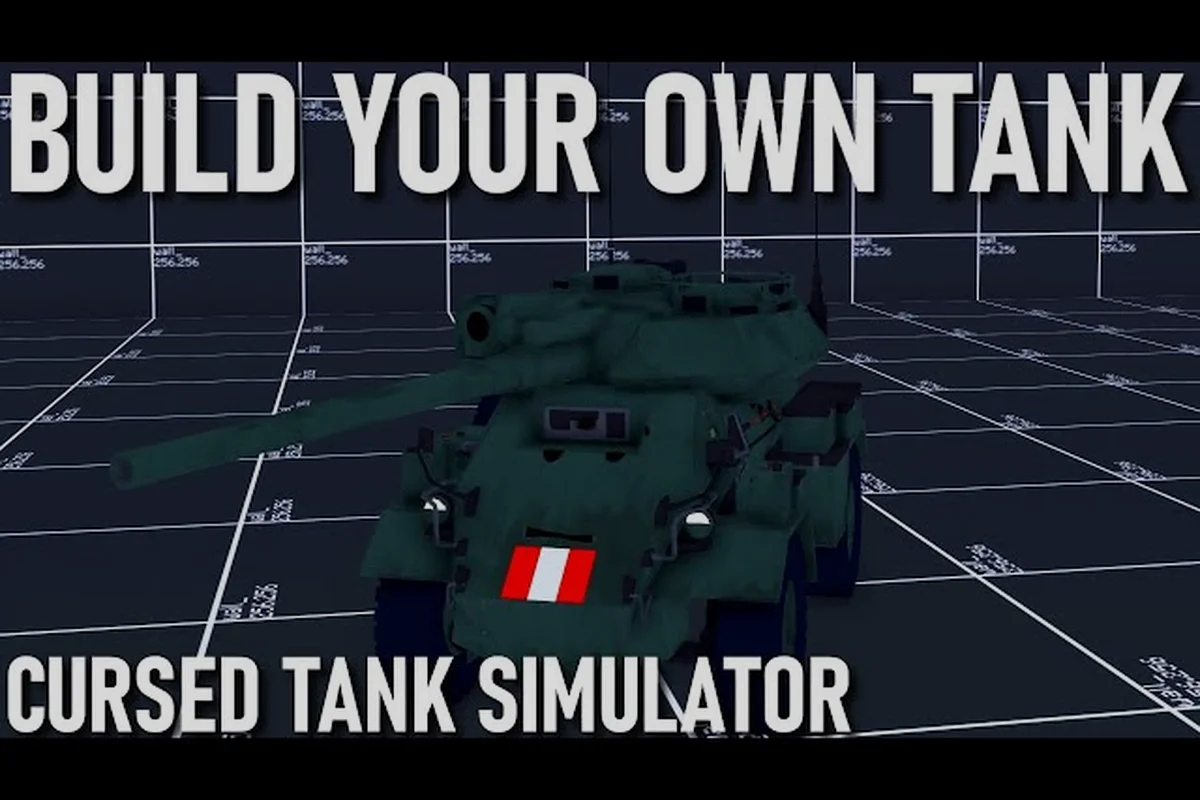
The Cursed Tank Simulator module system is the heart of the game's identity — it lets you bolt a tier 12 cannon onto a light tank chassis and call it a day. Understanding how modules work is the difference between driving a meme and driving a monster, because every armor plate, engine block, and turret ring changes your tank's stats in ways that compound across the whole build. This guide breaks down the module categories, how stats interact, and which combinations actually perform in combat.
The official Roblox page describes the core loop simply: "Create your very own cursed tanks by mixing and matching modules and fight with other players!" That one sentence hides a surprisingly deep system where five module slots — armor, engine, turret, cannon, and tracks — each pull from a pool of dozens of options spanning tiers 1 through 12. The cursed part comes from the freedom: nothing stops you from pairing a paper-thin hull with a railgun that deletes anything it touches, and that flexibility is exactly why the community keeps experimenting with the cursed tank simulator module system.
Core Module Slots and How They Interact
Every tank in Cursed Tank Simulator is assembled from five interchangeable module slots, and the cursed tank simulator module system calculates your final combat stats by combining the values from each slot with the base chassis. The armor module determines your hull's hit points and damage reduction, the engine module sets your top speed and acceleration, the turret module controls rotation speed and aiming stability, the cannon module defines your damage output and reload time, and the track module affects off-road mobility and turning radius. Because these stats multiply rather than add, a single weak slot can drag down an otherwise excellent build.
The interaction between slots creates the "cursed" builds the game is named after. A heavy armor module slows you down, so pairing it with a weak engine produces a sluggish bunker that can't reposition. Conversely, a top-tier engine on a light chassis gives you insane acceleration but leaves you vulnerable to any hit that lands. Community testing reported by players on the official Roblox page shows that the module system rewards specialization — you can build a glass cannon, a brawler, or a sniper, but you cannot build a tank that excels at everything simultaneously.
Module Tiers and Stat Scaling
Each module category has its own progression from tier 1 up to tier 12, and the stat scaling between tiers is not linear. A tier 8 cannon might deal roughly 1.5x the damage of a tier 6 cannon, but a tier 10 cannon can deal 2.5x the damage of that same tier 6 — the jump between tiers 8 and 10 is where most builds start to feel truly powerful. The same pattern holds for armor and engines, which is why players grind through mid-tier modules quickly rather than savoring them.
| Module Slot | Primary Stat | Secondary Stat | Tier 1 Example | Tier 12 Example |
|---|---|---|---|---|
| Armor | Hit Points | Damage Reduction | Light Steel Plate | Composite Reactive Armor |
| Engine | Top Speed | Acceleration | Small Gasoline Engine | Turbine Hybrid Drive |
| Turret | Rotation Speed | Aim Stability | Fixed Mount | Stabilized Autoloader |
| Cannon | Damage Per Shot | Reload Time | 20mm Autocannon | 152mm Railgun |
| Tracks | Off-Road Mobility | Turning Radius | Standard Tracks | Adaptive Smart Tracks |
The stat scaling matters because it determines your grind strategy. If you are chasing the cursed tank simulator best modules, you want to prioritize the slots that give the largest percentage improvements per tier. According to community data from the research report, cannons and armor modules show the steepest scaling curves, while engines and tracks plateau earlier — meaning a tier 9 engine is often "good enough" while a tier 9 cannon still leaves you at a serious disadvantage against tier 11 opponents.
How Module Stats Affect Combat Performance
The cursed tank simulator module system translates raw stats into combat outcomes through three main mechanics: damage calculation, mobility handling, and survivability checks. Damage calculation starts with the cannon's base damage, then applies modifiers from the turret's aim stability (which reduces spread when firing on the move) and the armor's damage reduction (which subtracts a percentage from incoming hits). Mobility handling uses the engine's top speed and the tracks' off-road multiplier to determine how quickly you can cross different terrain types, while survivability checks pit your armor's hit points and damage reduction against the enemy cannon's penetration value.
Understanding these mechanics helps you make smarter choices when you are learning how modules work in practice. A high-damage cannon is useless if your turret cannot rotate fast enough to track a fast-moving target, and a thick armor module is wasted if your engine cannot carry it to the fight in time. The best builds balance these trade-offs based on the map and the game mode you are playing, which is why the map guide recommends different loadouts for open fields versus urban environments.
Damage and Penetration Mechanics
Damage in Cursed Tank Simulator follows a penetration-first model: if your cannon's penetration value exceeds the enemy's armor rating, you deal full damage; if it falls short, you deal reduced damage or ricochet entirely. This makes the cannon penetration stat one of the most important numbers in the game, because it determines which enemies you can actually threaten. A tier 8 cannon with 200 penetration will struggle against tier 10 tanks with 250 armor, even if its raw damage per shot is respectable.
| Cannon Tier | Base Damage | Penetration | Reload Time | Effective Range |
|---|---|---|---|---|
| Tier 4 | 45 | 60 | 2.5s | 200m |
| Tier 6 | 85 | 110 | 3.2s | 300m |
| Tier 8 | 150 | 180 | 4.0s | 400m |
| Tier 10 | 280 | 320 | 5.5s | 500m |
| Tier 12 | 450 | 520 | 7.0s | 600m |
The trade-off between damage and reload time creates distinct playstyles. High-tier cannons deal massive damage per shot but punish misses heavily, while lower-tier autocannons let you spray damage but struggle against heavy armor. Community videos like The ACTUAL Best Guns in CTS by KatForce break down which cannons perform best at each tier, and the consensus is that penetration matters more than raw damage for most matchups because it determines whether you can hurt the enemy at all.
Best Armor and Engine Modules by Tier
Currency Drain Analysis: Gold vs. Cash for Module Research
The module system's progression economy hinges on two currencies: Gold and Cash. Redeeming the code 'WeAreSoBack' grants 250 Cash and 20,000 Gold, while 'code' provides 35,000 Gold, 5 Chromium, 3 Titanium, 500 Coal, and 200 Iron Ore. This disparity means Cash is the bottleneck for early-tier research, whereas Gold fuels high-tier module unlocks. Prioritize spending Cash on tier 1-5 modules, reserving Gold for experimental modules and Cyberware purchases. Mismanaging this split forces players into excessive grinding, delaying access to the tier 8 IS-7 and tier 10 M1 modules.
When players ask about the cursed tank simulator best armor module or the cursed tank simulator best engine, the answer depends on your tier bracket and playstyle. For armor, the community generally ranks Composite Reactive Armor as the best tier 12 option because it combines high hit points with a damage reduction bonus that triggers on incoming fire. Below tier 12, the Reinforced Steel Plate at tier 8 offers the best balance of protection and weight, while the Lightweight Alloy at tier 6 is popular for speed-focused builds that cannot afford the weight penalty of heavier armor.
For engines, the Turbine Hybrid Drive at tier 12 is the clear winner for top speed, but it comes with a high weight cost that forces you to compromise on armor. The Diesel V12 at tier 8 is the community favorite for mid-tier builds because it offers 80% of the top speed at half the weight, letting you maintain decent mobility while still carrying meaningful armor. The Electric Motor at tier 6 is the best budget option for light tanks that want instant acceleration for hit-and-run tactics.
| Tier Bracket | Best Armor Module | Best Engine Module | Build Type |
|---|---|---|---|
| Tier 1-4 | Standard Steel | Small Gasoline | Starter / Learning |
| Tier 5-7 | Lightweight Alloy | Electric Motor | Speed / Scout |
| Tier 8-10 | Reinforced Steel | Diesel V12 | Balanced / Brawler |
| Tier 11-12 | Composite Reactive | Turbine Hybrid | Heavy / Sniper |
The best module setup for your tank depends on the role you want to play, and the best module setup guide covers specific loadouts for each playstyle in detail. For new players, the most important takeaway is that you should prioritize armor and cannon modules first, because they have the largest impact on your ability to win fights. Engines and tracks are secondary upgrades that you can refine once you have a solid combat foundation.
How Modules Amplify Each Other Across Slots
The cursed tank simulator module system really shines when you start combining modules that amplify each other's strengths. The most popular synergy in the current meta is pairing a high-penetration cannon with a stabilized turret that reduces aim spread, allowing you to snipe weak points from long range without needing to stop moving. This combination is particularly effective on open maps where you can keep distance from brawlers, and it is the foundation of most competitive sniper builds.
Another strong synergy involves heavy armor paired with a high-torque engine that sacrifices top speed for acceleration. This lets you reach combat speed quickly from a standstill, which matters in close-quarters maps where the first shot often decides the engagement. The adaptive tracks module amplifies this further by improving your off-road mobility, letting you traverse rough terrain that would bog down standard tracks. Community reports suggest that this combination is the most forgiving for new players because it forgives positioning mistakes.
Experimental and Drone Modules
Beyond the five standard slots, the game includes experimental modules and drone modules that add extra build variety for advanced players. Experimental modules are unlocked through progression and offer unique effects like increased fire rate at the cost of accuracy, or bonus damage against specific armor types. Drone modules deploy a small autonomous unit that provides either reconnaissance, suppressive fire, or defensive shielding depending on the variant you equip.
| Module Type | Effect | Unlock Cost | Best Used For |
|---|---|---|---|
| Experimental Cannon | +15% fire rate, -10% accuracy | 5 Cyberware | Close-range brawling |
| Experimental Armor | +20% HP, +15% weight | 4 Cyberware | Heavy assault |
| Recon Drone | Reveals enemies within 200m | 3 Cyberware | Open map sniping |
| Shield Drone | Blocks 1 hit every 30s | 3 Cyberware | Aggressive pushes |
These advanced modules require Cyberware, a rare currency that you earn from high-tier matches and special events. The experimental modules guide explains the unlock requirements and costs in detail, but the key point is that these modules are not strictly better than standard options — they trade one stat for another, and the best choice depends on your build philosophy. If you want to maximize your tank's potential, learning to use these modules effectively is the next step after mastering the standard five slots.
Module Upgrade Paths and Resource Management
Upgrading modules in Cursed Tank Simulator requires multiple currencies, and the cursed tank simulator module system uses Gold, Cash, Coal, Iron Ore, Chromium, Titanium, and Cyberware depending on the module tier and type. Lower-tier modules cost Gold and Cash, while higher-tier modules require rarer materials like Chromium and Titanium. The research report notes that redeeming the code "code" grants 35,000 Gold, 5 Chromium, 3 Titanium, 500 Coal, and 200 Iron Ore, which gives new players a solid resource foundation to start upgrading.
The upgrade path for each module follows a linear progression: you start with the base module, then spend resources to increase its level, which boosts its stats by a fixed percentage per level. The cost per level increases exponentially, so the first few levels are cheap while the final levels can drain your entire resource stockpile. Community data suggests that leveling a module to level 5 gives you 80% of its maximum potential at roughly 30% of the total cost, making it the most efficient stopping point for most players.
| Module Level | Stat Increase | Upgrade Cost | Efficiency Rating |
|---|---|---|---|
| Level 1-3 | +10% per level | Low | Excellent |
| Level 4-6 | +8% per level | Medium | Good |
| Level 7-9 | +5% per level | High | Fair |
| Level 10 | +3% final | Very High | Poor |
Resource management is crucial because you cannot max out every module — you have to prioritize the slots that matter most for your build. The speed module guide covers how to balance survivability modules against speed modules, but the general advice is to max out your cannon and armor first, then allocate remaining resources to engine and turret upgrades. Tracks are usually the last priority because their stat gains are smaller and less impactful in most combat scenarios.
Frequently Asked Questions
How does the cursed tank simulator module system work?
The module system lets you mix and match five core slots — armor, engine, turret, cannon, and tracks — from a pool of options spanning tiers 1 through 12. Each module contributes stats that combine multiplicatively to determine your tank's combat performance. You can create specialized builds like glass cannons or heavy brawlers by choosing modules that complement each other.
What is the best armor module in the game?
The Composite Reactive Armor at tier 12 is the best armor module, offering the highest hit points plus a damage reduction bonus on incoming fire. Mid-tier players should use the Reinforced Steel Plate at tier 8 for balanced protection and weight. Your choice depends on your tier bracket and survivability priorities.
Which engine module should I use for a fast build?
The Turbine Hybrid Drive at tier 12 offers the highest top speed, but its heavy weight forces you to compromise on armor. The Electric Motor at tier 6 is the best budget option for light tanks that want instant acceleration. For most players, the Diesel V12 at tier 8 provides the best balance of speed and weight for mid-tier builds.
How do I unlock experimental modules?
Experimental modules require Cyberware, a rare currency earned from high-tier matches and special events. You also need to progress through the standard module research tree to unlock the experimental branch. The unlock costs range from 3 to 5 Cyberware per module, and each experimental module trades one stat for another rather than being strictly better than standard options.
What modules should I prioritize as a new player?
New players should prioritize cannon and armor modules first, as they have the largest impact on winning fights. Focus on leveling these to level 5, which gives 80% of their maximum potential at 30% of the total cost. After that, upgrade your engine and turret to improve mobility and aiming, leaving tracks for last since their stat gains are smaller.